
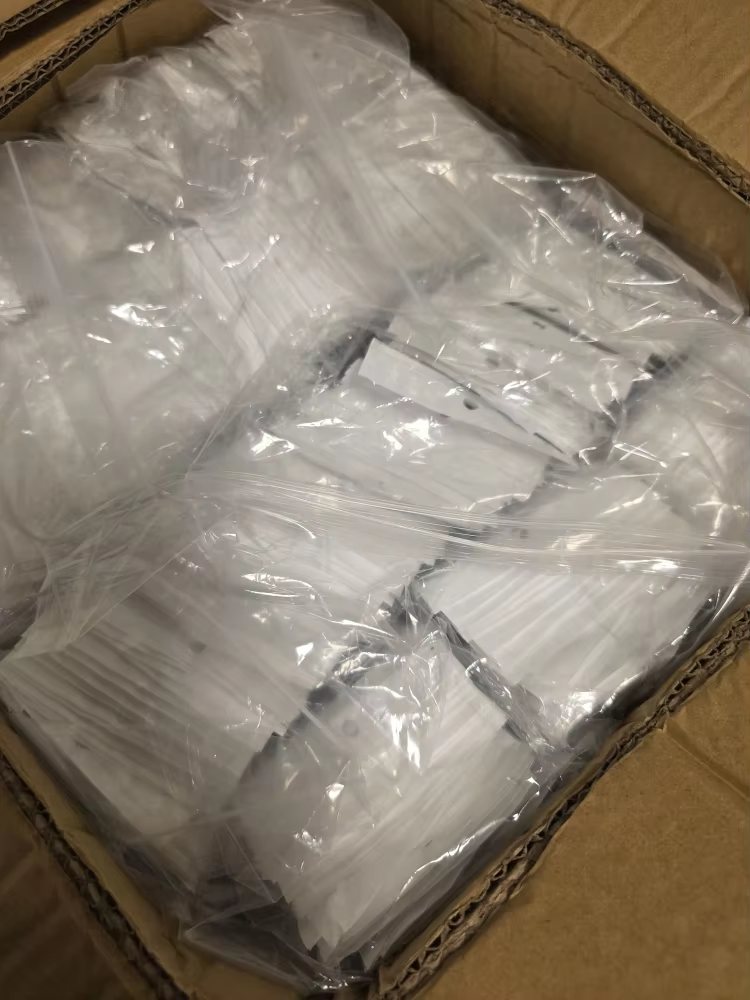
A holder that costs the same either way can sell very differently depending on the box. Retail packaging is also the part of an order most likely to be changed at the worst possible moment, so it is worth deciding before the first quote rather than after.
Four levels of packaging
| Level | What it is | Best for |
|---|---|---|
| 1. Protective only | PE bag or plain white box | Market testing, bulk to a distributor who packs their own |
| 2. Plain box + label | Neutral box with your printed label and barcode | First orders and small brands starting out |
| 3. Printed retail box | Your artwork printed on the box | Selling on marketplaces or in shops |
| 4. Retail set | Box + insert or tray + manual + barcode | Corporate gifting, premium ranges, retail chains |
Most first orders work well at level 2 or 3. Level 2 keeps the cost low and still looks finished on a shelf; level 3 is what you move to once a model proves it sells.
What drives the price of a printed box
- Structure — a simple tuck-end box costs far less than a rigid magnetic box with a tray.
- Board and printing — white card with offset printing is the standard; special boards and finishes add cost.
- Finishing — matt or gloss lamination, spot UV, foil. Each is a separate pass and a separate setup.
- Quantity — box printing has its own setup, so the unit cost falls sharply with quantity. This is why the box, not the product, is usually the reason a very small order is expensive.
- Insert — a moulded tray protects better and costs more than a folded cardboard insert.
If your target price is tight, keep the box structure simple and put the money into the print quality. Buyers notice a clean, well-printed simple box more than a complicated structure with dull printing.
What we need to quote and produce a box
- A die-line or template with the exact internal dimensions, in AI, PDF or EPS.
- Artwork placed on the die-line, with fonts outlined and images at 300 dpi.
- The barcode as a vector, or the numbers so we can generate and verify it.
- Whether the box must fit an insert, a cable, or a manual.
- Any required marks for your market — for example country of origin, recycling symbols, or your importer's address.
If you only have a flat logo file and a rough idea of the size, we can prepare the die-line and place the artwork, but the design approval step takes longer, so say so at the start.
Barcodes and market marks
Three things are worth settling before the box is printed, because reprinting is expensive:
- The barcode. Marketplace sellers need the code the marketplace assigns (for example an FNSKU), while retailers usually need an EAN or UPC registered in your name.
- Country of origin. Several markets, including the United States, require the country of origin to be marked on the product or its packaging for imported goods.
- Importer details. Many markets require the importer's name and address on the retail packaging, so add it to the artwork rather than as a sticker later.
We print what you specify. We do not tell you what your market requires — that answer should come from your importer or your compliance adviser, and it is much cheaper to get it before the first print run.
How packaging fits the timeline
Two clocks run in parallel. The product follows its own sequence: drawing confirmed, sample 7–10 working days, production 7–12 days after approval. The printed packaging follows its own: artwork approved, printing, delivery to our plant.
When the packaging arrives before production finishes, packing and final inspection take the last 3–5 days and the order ships. When it arrives late, the goods sit finished on the floor — which is the most expensive place in the factory.
Five mistakes that cost money
- Approving artwork, then changing the text. Every change after the plates are made is a new setup.
- Printing a barcode that the marketplace does not accept, then covering it with a label on every unit.
- Sizing the box to the product only, with no allowance for the holder, the manual and the packing tolerance.
- Forgetting the importer details that your market requires.
- Leaving packaging to the same week as production, so a small print delay becomes a shipping delay.
The short version
Start at level 2. Move to a printed retail box when a model proves itself. Send the die-line and outlined artwork, settle the barcode and market marks first, and approve the packaging at the same time you approve the sample — not three weeks later.
Need a price for your own model?
Send us your drawing or a reference photo. You will get unit price, sampling time and shipping cost within one working day.
Models mentioned in this guide