
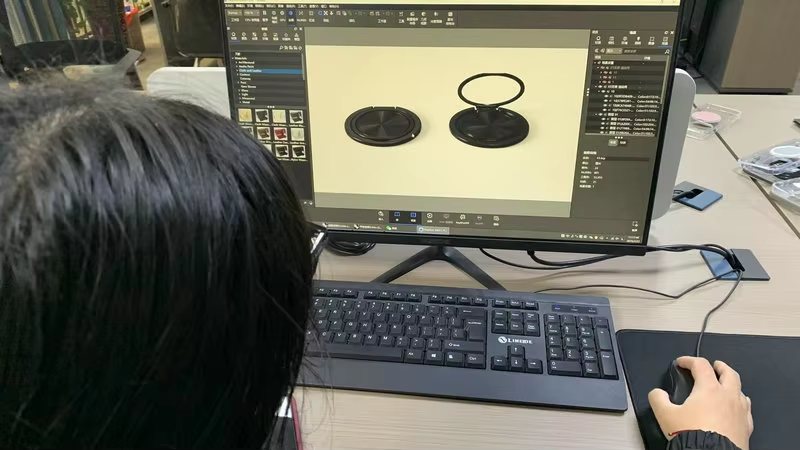
A magnetic ring holder looks like a simple product, and that is exactly why so many ranges fail: buyers pick four designs that look good together, and then discover that two of them do not fit the cases their customers actually use.
Step one: decide how the phone is held
| How it is used | What to pick | Why |
|---|---|---|
| Held in one hand, scrolling | Flat magnetic ring holder | Adds grip without adding bulk |
| Watching video on a desk or tray table | Folding kickstand | Holds an angle hands-free |
| In a car, on a vent or dashboard | Car mount with a hinged arm | Needs stiffness, not just magnetism |
| Mounted on a bike or in a workshop | Double-sided magnetic holder | Holds firm through vibration |
Pick one model per use case and you have a range of four that does not compete with itself. Pick four ring holders in four colours and you have four products fighting for the same buyer.
Step two: match it to the case your customers use
- Bare phone or thin case. A flat ring holder is enough. Our standard models are 3.8–5.8 mm thick.
- Thick or rugged case. Look for a holder with a stronger magnet and a larger contact area, or a double-sided model that grips the case from both faces.
- MagSafe-style case. The ring must sit flat against the back — check that the ring diameter does not overlap the camera bump.
- Mixed market. Sell one flat model and one double-sided model; between them they cover almost every phone in the shipment.
Step three: the five specifications that decide whether it feels good
- Magnet strength. Our standard ring models use N52 magnets measured at about 4,100 GS. Too weak and the phone slides; too strong is rarely the complaint.
- Hinge life. The SK7 hinge used in several of our models is cycle tested to more than 6,000 open-and-close movements. Ask for the number, not for the word “durable”.
- Thickness and weight. 3.8 mm and 18 g is a flat ring; 4.5 mm and 25 g is a double-sided holder. Quote both numbers to your buyers.
- Surface finish. Anodised aluminium keeps its colour; painted parts do not, after a few months in a pocket.
- Colour consistency between batches. Ask how the finish is matched — this is the difference between a repeat order and a complaint.
Building a first range of three
A first order does not need to be 21 models. Three models, done properly, will tell you more than twenty done badly:
- One flat ring holder in your best-selling colour.
- One double-sided holder for thick cases and rough use.
- One folding kickstand for the video-watching use case.
Add the colours your market actually buys, and keep the rest of the range for the second order once you know which one moves.
What actually moves the unit price
- Quantity — setup cost is shared across the batch.
- Material grade — 7075 costs more than 6063.
- Logo method — laser engraving is cheaper than silk-screen or UV in small runs, and more expensive in large ones.
- Packaging — a printed retail box can cost more per unit than the holder itself on small orders.
- Colour — a stock anodised finish is cheaper than a custom colour match.
If you need to hit a price point, change the packaging and the colour first. Changing the magnet or the hinge is where quality actually disappears.
Six-point checklist before you order
- Which phone and which case will the average buyer use?
- Which of the four use cases am I selling into?
- Have I asked for measured magnet strength and cycle-test numbers?
- Is the finish anodised or painted?
- Does the packaging cost more per unit than it needs to?
- Have I ordered a sample of each model before committing to the batch?
The short version
Choose by use case and by case, not by colour. Ask for measured numbers instead of adjectives. Start with three models and a sample of each, then extend the range where the data takes you.
Need a price for your own model?
Send us your drawing or a reference photo. You will get unit price, sampling time and shipping cost within one working day.
Models mentioned in this guide