
What a Custom Magnetic Phone Holder Quotation Actually Contains
A complete quotation has five cost blocks: unit product cost, tooling (only if a new mold is required), logo and surface treatment, packaging, and testing or certification. Our MOQ is 50 pcs per model, including custom logo, color and packaging, so a first order does not require a container-scale commitment.
Unit product cost itself is built from material, molding cycle time, magnet grade, hardware, assembly labor and finishing. When a buyer asks why two suppliers quote differently for what looks like the same stand, the difference is usually in magnet grade, wall thickness, hinge construction and whether the finish is sprayed or anodized — not in the assembly step.
Tooling is a separate, one-time line. It should never be folded silently into the unit price, because it is paid once and then amortized across future orders. Ask for it as a distinct line item with its own lead time.
Testing and certification are also separate. We hold no default CE, RoHS, REACH, FCC or SGS certificates; third-party testing is arranged per order when the buyer requires it. Treating this as a distinct line prevents the common surprise of discovering mid-production that a test report was assumed rather than ordered.
Ask every supplier to split tooling, testing and certification into their own lines. A single blended unit price hides which costs repeat and which do not.
MOQ: Why 50 Pcs Per Model Is the Starting Point
Our MOQ is 50 pcs per model, and that figure already includes custom logo, custom color and custom packaging. It is not a bare-unit threshold with customization added on top.
MOQ is set by setup cost, not by goodwill. Each production run consumes a mold setup, a color change, a logo program and a packaging setup. At 50 pcs those setups are spread across a small quantity, which is why the per-unit figure at MOQ is higher than at volume — the setup does not shrink, only its share does.
Two levers reduce effective cost without reducing quality. First, choose from the 21 models that are already tooled and ready to order, which removes tooling from the equation entirely. Second, keep color and logo consistent across models in the same order so setup is shared.
- MOQ 50 pcs per model, custom logo, color and packaging included
- 21 models already tooled and available without new tooling
- 100+ products in the catalog, with 20+ new models released each year
- Consolidating colors and logos across models shares one setup
For buyers validating a new SKU, 50 pcs is enough to run a real market test, confirm fit with MagSafe and Qi2 devices, and collect return data before committing to a larger run. See the OEM and ODM customization process for how a first order is scoped.
Lead Time: Sampling 7–10 Days, Production 7–12 Days, Packing 3–5 Days
Sampling takes 7–10 working days after drawings are confirmed; mass production takes 7–12 days after sample approval; packing and final inspection take a further 3–5 days. New tooling, when required, adds 4–6 weeks before sampling can begin.
| Stage | Duration | Starts When |
|---|---|---|
| New tooling (only if required) | 4–6 weeks | Tooling deposit and final 3D data confirmed |
| Sampling | 7–10 working days | Drawings confirmed |
| Mass production | 7–12 days | Sample approved |
| Packing and final inspection | 3–5 days | Production completed |
| Shipping terms | FOB Shenzhen | Goods packed and released |
These stages run in sequence, not in parallel, so a first order on a new mold is realistically a tooling phase plus a sampling phase plus a production phase plus packing. A repeat order on an existing model skips tooling and usually skips sampling, which is why reorders move substantially faster than first orders.
The most common cause of delay is not factory capacity but late buyer input: unconfirmed artwork, undecided Pantone references, or packaging dielines approved after production has started. Locking artwork and packaging before the sampling window closes is the single most effective schedule control a buyer has. Our notes on sampling to mass production delays cover this in detail.
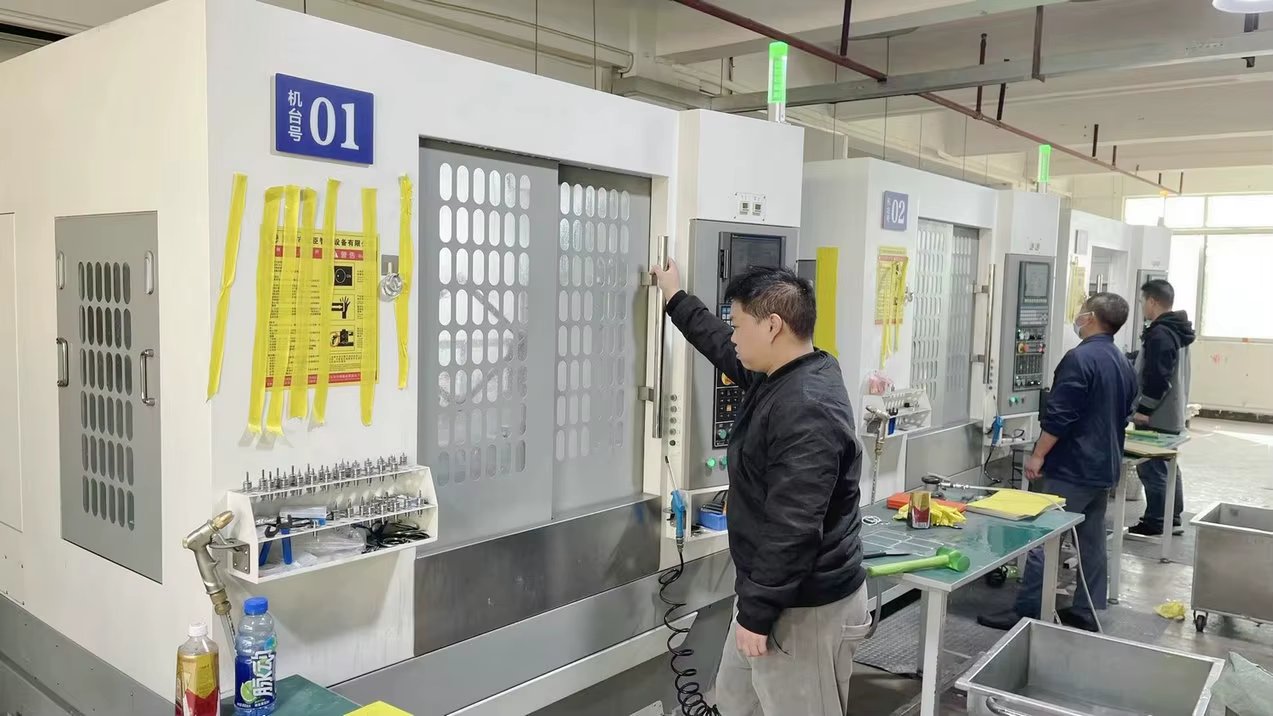
Capacity behind these windows: a 3,500 m² factory in Dongguan with 3 production lines, 27 machines and monthly output above 300,000 pcs. Feigangxia is a self-operated factory, not a trading company, so molding, injection, assembly and packing are controlled on site.
Tooling Costs: What Triggers Them and What Avoids Them
Tooling is required only when the part geometry does not exist yet. If you order one of the 21 already-tooled models, there is no tooling cost and no 4–6 week tooling lead time. If you need a new housing, a new hinge geometry or a new magnetic array layout, a new mold is built and the 4–6 week window applies.
Tooling scope is driven by part count and complexity, not by order quantity. A single-piece housing needs one mold; a folding stand with a separate hinge, base and magnet carrier may need several. Each additional molded part adds its own tool, its own trial cycle and its own sampling round.
Tooling is also affected by material choice. 6063 and 7075 aluminum, PC and PU behave differently in molding and finishing, and a design that is easy in PC may need draft and wall-thickness changes in aluminum. Reviewing material before cutting steel is cheaper than revising a mold afterward.
Two structural facts reduce tooling risk. We hold 8 granted Chinese patents (3 utility models and 5 design patents, CNIPA), so existing geometries are protected and documented. And we handle injection molding, assembly and packing in-house, which means tooling trials and sampling feedback stay within one team.
Tooling Decision Checklist
- Confirm whether an existing tooled model meets the requirement — 21 are available now
- If not, define the minimum number of molded parts to limit tool count
- Fix material (6063/7075 aluminum, PC, PU) before tooling is cut
- Confirm surface treatment and logo method, since both affect tooling and fixture design
- Approve 3D data before the 4–6 week tooling window starts
- Plan sampling (7–10 working days) immediately after tooling trial
What Makes Unit Cost Go Up or Down
Six variables move unit cost: quantity, tooling status, material, surface treatment, logo method and packaging format. Quantity and tooling status are structural; the other four are specification choices the buyer controls directly.
Material is the largest specification lever. Aluminum bodies in 6063 or 7075 cost more than PC but change perceived value and heat behavior. Magnet grade matters too: N52 magnets, measured at approximately 4,100 GS on our OX-3 and CX-5 models, hold more securely than lower grades and are specified rather than substituted.
Surface treatment is the second lever. Anodizing produces a durable, consistent finish on aluminum; spraying and UV printing are alternatives with different durability and color-matching behavior. The choice affects both unit cost and how closely a brand color can be matched across batches.
Logo method is the third. Laser engraving, silk-screen printing and UV printing differ in setup, color capability and wear resistance. Engraving is permanent and single-color; UV printing supports multi-color artwork. Packaging is the fourth: a plain poly bag, a printed retail box and a full retail-ready set with inserts are three different cost structures.
Hardware durability also sits inside unit cost. Our SK7 hinge is tested to 6,000+ open-and-close cycles, which is a specification you can quote in a product listing rather than an unverifiable claim.
Cost Driver Reference
| Driver | Raises Cost When | Lowers Cost When |
|---|---|---|
| Quantity | Order is at or near MOQ 50 pcs | Volume amortizes setup across more units |
| Tooling | New geometry requires a new mold (4–6 weeks) | Using one of 21 already-tooled models |
| Material | 6063/7075 aluminum, N52 magnets | PC or standard magnet grades |
| Surface treatment | Anodizing, multi-step finishing | Simple sprayed or unfinished surfaces |
| Logo method | Multi-color UV printing, tight color matching | Single-color laser engraving |
| Packaging | Printed retail box with inserts | Plain protective packaging |
Testing follows the same logic. Because we hold no default CE, RoHS, REACH, FCC or SGS certificates, any required third-party testing is quoted per order and adds both cost and calendar time. Buyers who need a test report should state it at inquiry stage, not after production.
How to Compare Two Quotations Fairly
Compare quotations on structure, not on the bottom-line unit price. A lower unit price with tooling, testing and packaging buried inside is not comparable to a higher unit price with those lines shown separately.
- Is tooling a separate line, and is it one-time?
- Is the MOQ stated per model, and does it include logo, color and packaging?
- Are magnet grade and hinge cycle rating specified, or left as 'high quality'?
- Is surface treatment named (anodizing, spraying, UV printing)?
- Is testing quoted separately, and is the certificate status stated honestly?
- Are sampling, production and packing lead times given as separate windows?
- Is the shipping term stated, for example FOB Shenzhen?
A supplier that answers these seven points in writing is easier to audit later. We sign NDAs on request and provide logo copyright registration 2024-F-00271084 and trademark registration 80143576 (Class 9) as documentation of brand ownership.
For a first order, the practical sequence is: confirm an existing tooled model or approve new tooling, lock material and finish, approve artwork and packaging, run sampling in 7–10 working days, approve the sample, then produce in 7–12 days with 3–5 days for packing and final inspection. Start a specification review through the contact page or review the OX-3 magnetic stand as a reference build.
Need a price for your own model?
Send us your drawing or a reference photo. You will get unit price, sampling time and shipping cost within one working day.
Frequently asked questions
What is the MOQ for a custom magnetic phone holder with logo, color and packaging?
The MOQ is 50 pcs per model, and that quantity already includes custom logo, custom color and custom packaging. It is not a base-unit threshold with customization charged on top. Because 21 models are already tooled, a first order can be placed on an existing design without any tooling cost or the 4–6 week tooling lead time. Buyers testing a new SKU can therefore validate fit with MagSafe and Qi2 devices at a small quantity before scaling.
How long does a custom order take from drawing confirmation to shipment?
Sampling takes 7–10 working days after drawings are confirmed. Mass production takes 7–12 days after sample approval, and packing plus final inspection take a further 3–5 days. If a new mold is required, add 4–6 weeks for tooling before sampling can start. These stages run in sequence, so a first order on new tooling is longer than a reorder on an existing model. Shipping terms are FOB Shenzhen.
Do you provide CE, RoHS, REACH, FCC or SGS certificates by default?
No. We do not hold CE, RoHS, REACH, FCC or SGS certificates by default. When a buyer requires third-party testing, it is arranged per order and quoted as a separate line, which adds both cost and calendar time. Buyers who need a test report should state the requirement at inquiry stage so it can be scheduled alongside sampling and production rather than after production has finished.
Models mentioned in this guide