
Almost every first-time buyer opens with the same question: which city should I be sourcing from? It is the wrong first question, but not an unreasonable one, because the three best-known sourcing cities in China really do sell you different things.
What each city actually sells
The difference between them is not a ranking of quality. It is the shape of the order each one is built to handle.
| City | Who you are usually talking to | Typical order | Choose it when |
|---|---|---|---|
| Dongguan (Guangdong) | Component and finished-goods factories with their own mould shop and assembly lines | Custom OEM, from 50 pcs on existing tooling | You need a structural change, your own packaging, or repeatable production you can audit |
| Shenzhen (Guangdong) | Design houses, trading companies and electronics suppliers | Electronics, mixed categories, rapid prototyping | The product needs a circuit or a charging coil, or you want one company coordinating several suppliers |
| Yiwu (Zhejiang) | Wholesale market stalls and small trading firms | Ready goods, small mixed orders, retail packaging | You want what already exists, in small quantities, with no tooling |
Yiwu's model is built for buyers who take what already exists. A factory town's model is built for buyers who want something changed. If your order is an existing model with your logo and your packaging, both routes can do it — but only one of them can move the magnets.
There is also a fourth answer that appears on no map: the supplier who already runs the exact product you are looking at. A factory that moulds magnetic holders every week will quote faster, sample faster and make fewer mistakes than a more general supplier in a better-known city.
Where the product is actually made
A magnetic phone holder is a small mechanical assembly: moulded parts or an aluminium body, one or more magnets, an adhesive layer or a ring plate, and sometimes a hinge. Tooling and injection moulding decide most of the cost, and in China both are concentrated in the Pearl River Delta — Dongguan, Shenzhen, Huizhou and the towns between them. That is why a plastic part quoted from Yiwu is still very often moulded in Guangdong.
Shenzhen's role is the layer above manufacturing. It is where the trading companies, the design houses and the electronics supply chain sit, which is exactly what you want if your product needs a charging coil or a mixed container. It is worth knowing that a large share of quotations sent from a Shenzhen address are placed at a factory in Dongguan or Huizhou. That is not a trick, but it does add a margin and one more link in the message chain between you and the production line.
Yiwu's role is distribution. It is a market, not a production base, and it is very good at what it is for: fast, small, mixed orders of goods that already exist. What it usually cannot give you is a structural change, a mould you own, or a direct line to the people who run the machines.
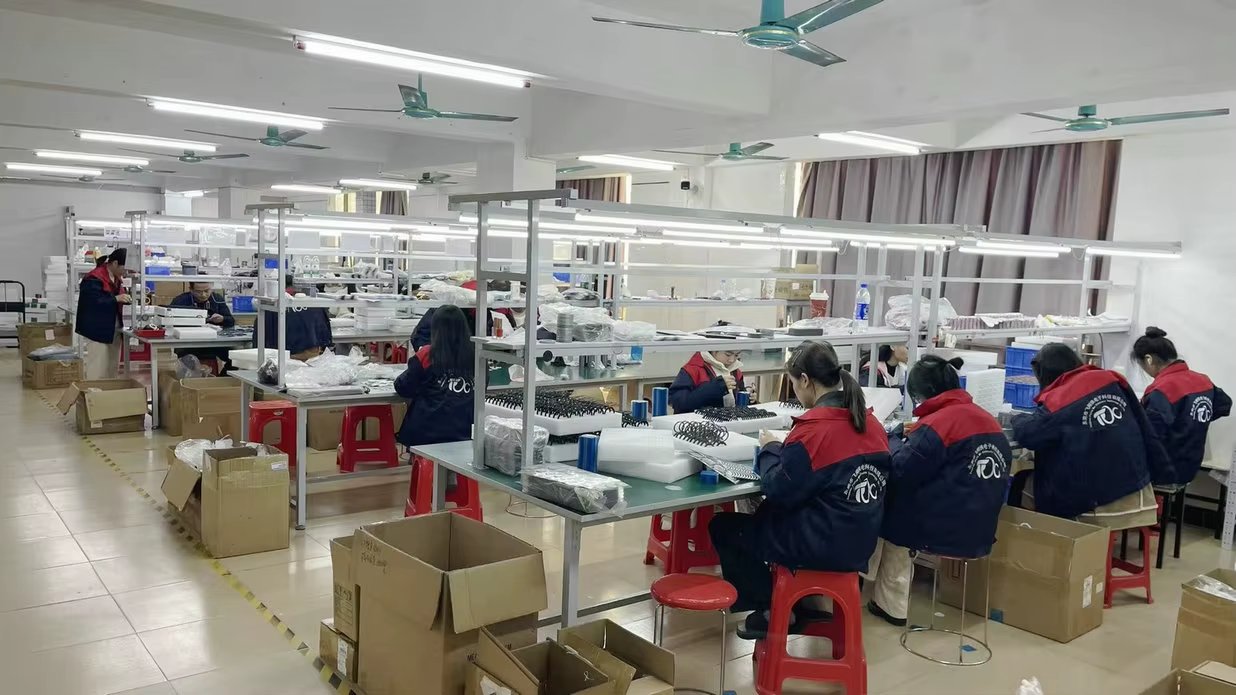
For reference, our own position: mould making, injection moulding, assembly and packing all run inside the same 3,500 m² plant in Dongguan, and we ship FOB Shenzhen. For us those two cities are not alternatives — one is the factory, the other is the port.
Five questions that matter more than the city
Whichever route you pick, these five answers will tell you more about the order than the city printed on the invoice.
- Who owns the tooling? If the answer is the factory and not you, you cannot move the product to another supplier later without starting again.
- Can we see the mould shop? A trading company cannot show you one. A factory can, and will send a video of the actual mould rather than a stock photo.
- Who signs the inspection report? Ask what is checked, from incoming magnet inspection to the final functional test, and who puts their name on it.
- Which parts are bought in? Magnets, adhesives, anodising and printing are normally subcontracted. Ask which ones, and how incoming parts are verified.
- What happens if the first batch fails? Get the rework and replacement rule in writing before you pay a deposit, not after.
MOQ, lead times and shipping on each route
- Factory, existing tooling. MOQ 50 pcs per model, including your logo, colour and packaging — that is our own number, and it applies to every model we already run. Samples leave 7-10 working days after the artwork is approved; mass production takes 7-12 days after you approve the sample, then 3-5 days for packing and final inspection. Goods ship FOB Shenzhen.
- Trading company. The minimum is often more flexible, because your order can be merged with someone else's. The trade-off is a margin and one less degree of control over the schedule.
- Wholesale market. The minimum is usually a carton, or a mixed carton. It is the fastest route to goods and the slowest route to your own product.
One detail worth checking before you book freight: goods from Guangdong leave through Yantian, Shekou or Nansha, while Yiwu normally ships through Ningbo or Shanghai. If your forwarder is already booked on a different port, the cheaper product can turn into the more expensive order.
How to check a supplier in any of these three cities
- Ask for a live video walk-through of the line, not a photo set. Photos are free; a walk-through is not.
- Ask for the number of a mould they already run, and what it makes.
- Buy one sample of an existing model and measure it yourself before you discuss tooling.
- Ask which certifications they hold. For a passive aluminium holder an honest answer may well be none; we hold eight granted patents in China (CNIPA) and can send the numbers, and we do not hold CE, RoHS, REACH or SGS certificates, which we say plainly rather than imply.
- Get the same three quotations and compare what is inside the price, not the price. Packaging, logo method and inspection scope are where the differences usually hide.
Which one should you choose?
Ready goods, small quantity, quickly: a wholesale market. Electronics or several categories in one container: a Shenzhen integrator. Your brand, your changes, your packaging, and a product you intend to reorder: a Guangdong factory — and ask to see the mould.
Questions buyers ask us about sourcing regions
Is a Dongguan factory more expensive than a Yiwu trader?
The two are not selling the same thing, so the unit prices are not comparable. A trader's price carries their margin; a factory's price carries the tooling and the version you specified. Compare the delivered cost of the exact product you want, packaging included, and the ranking usually changes.
Do I have to visit China to work with a factory?
No. Most of our first orders run on a drawing, a paid sample and a video inspection. Visiting helps when you want to change the structure, but it is not required for a logo and packaging order.
Can I really start at 50 pieces?
On any model we already run, yes — 21 of them are already on tooling. MOQ 50 pcs per model, including your logo, colour and packaging. A brand-new product needs a new mould and a larger starting quantity.
What is the fastest route to a first shipment?
Take an existing model, send your logo file and packaging artwork, approve the sample, and the batch runs 7-12 days after approval, plus 3-5 days of packing and final inspection.
How to start
Send three things: the model you are considering, your target quantity, and the market you sell in. You will get the unit price, the sample date and a freight estimate in one reply. If you are still comparing designs, ask for samples of two models instead of one — holding both answers more questions than a catalogue page.
Need a price for your own model?
Send us your drawing or a reference photo. You will get unit price, sampling time and shipping cost within one working day.
Models mentioned in this guide