
Direct answer: Fleet buyers should shortlist a phone mount by installation surface, phone-and-case fit, handling method and replacement plan, then approve the complete combination on representative vehicles before placing a bulk order. Product dimensions and a magnetic rating alone do not establish that a mount is suitable for a particular cabin, route or phone case.
Start with the fleet's real constraints
Create a short inventory before comparing models. The useful unit is not only the vehicle model; it is the surface where the mount will be fixed, the phone versions carried by staff, the cases used with those phones, and how drivers attach or remove the device during a shift.
- List the cabin surface, available fixing area and anything that must remain unobstructed.
- List the exact phone models and the cases used in each job role.
- Describe when the phone is mounted and removed during the route.
- Record whether the mount will be reused across vehicles or assigned permanently.
- Define a replacement item and cleaning routine before sampling.
This inventory prevents a common purchasing error: testing one attractive phone and one thin case, then discovering that the fleet also uses thick protective cases, different cabin surfaces or a different attach-and-release routine. Materially different case construction should create a separate test row, even when the case colours look identical.
Use a repeatable sample test
The sample stage is where the supplier and buyer should turn vague claims into a written result. Fix the product version, phone, case, mounting surface and test method before collecting observations.
- Record the product revision, phone model, case material and case surface.
- Inspect hinge movement, magnet placement, camera clearance and access to controls and ports.
- Attach the phone using the method drivers will use during a normal shift.
- Test the same combination repeatedly and record any movement, looseness or separation.
- Check the mounting point on representative cabin surfaces without obstructing controls, displays or safety equipment.
- Photograph each tested combination and assign one clear pass or fail result.
Do not convert a few successful attempts into a claim that the mount fits every vehicle or every case. The approval should identify the combinations actually tested and require a new check when the phone, case or mounting surface changes materially.
Compare verified model facts before sampling
A shortlist should contain products with enough published information to design the test. The following three models serve different roles in a magnetic accessory range:
| Model | Published facts | Use in a buying review |
|---|---|---|
| X23 car phone stand | 57 × 3.5 mm, 21 g, aluminium alloy body, SK7 hinge tested beyond 6,000 cycles and magnetic mounting | Review when the fleet needs a dedicated car-use stand and can confirm the exact mounting surface. |
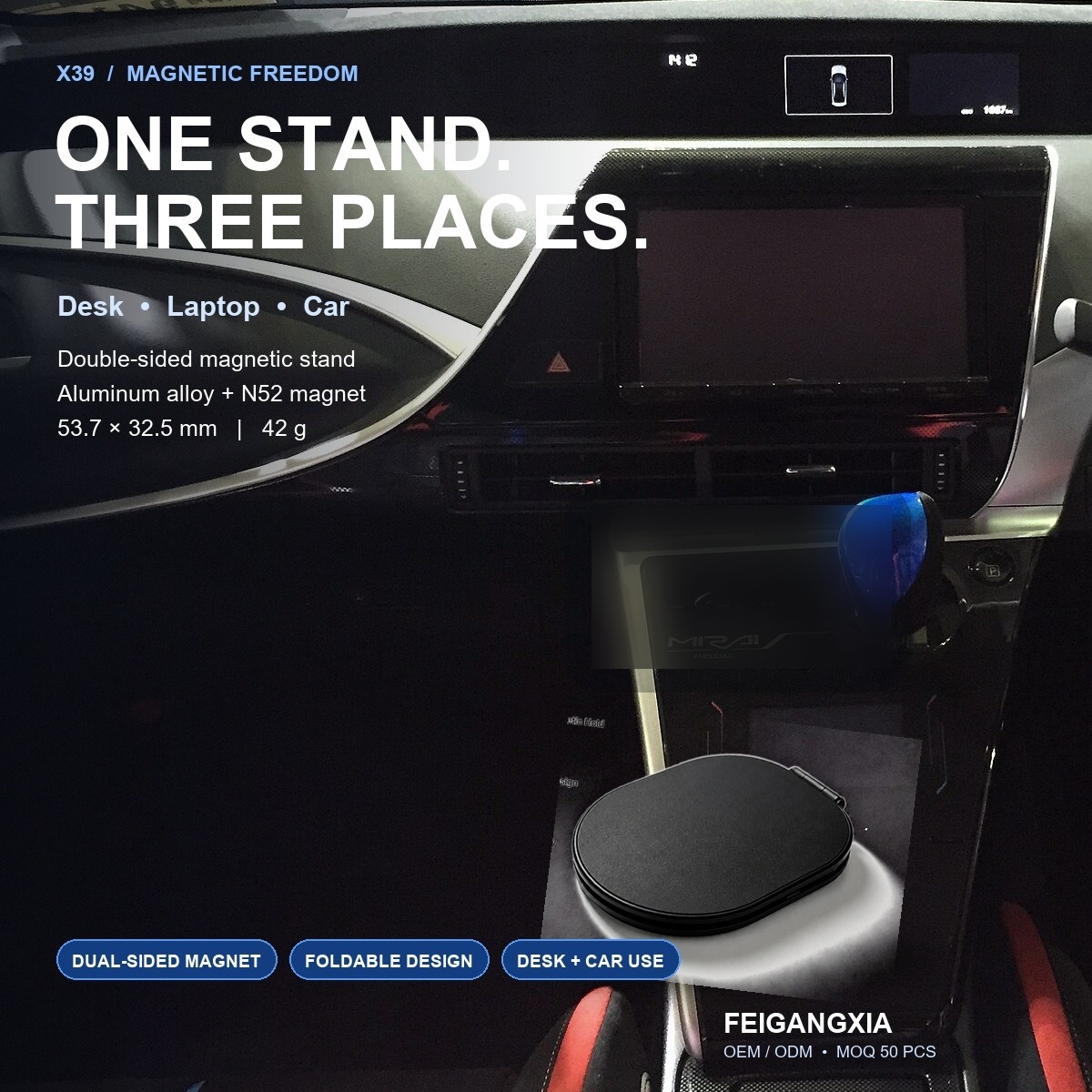
| X39 | 53.7 × 32.5 mm, 42 g, aluminium alloy with an N52 magnet, double-sided magnetic and foldable; published use includes car use | Review as a compact double-sided magnetic holder for desk, laptop and compatible car mounting use. |
| OX-3 | 58 × 4.5 mm, 25 g, N52 magnet measured at about 4,100 GS on the assembled product, dual-magnet construction | Review when a magnetic phone-side interface must pair with a separately tested car mount. |
These facts define the sample request; they do not prove fit in a particular vehicle. Open the <a href="../products/x23">X23 page</a>, <a href="../products/x39">X39 page</a> and <a href="../products/ox3">OX-3 page</a> before choosing the test set.
Build an approval record that survives staff changes
The signed record should let a second buyer reproduce the test without asking what was meant by “held well”. Include the product revision, phone, case, mounting surface, attach-and-release method, inspection result and decision.
- Supplier model code and sample revision.
- Phone model and actual case used.
- Mounting surface and fixing method.
- Hinge, magnet and clearance observations.
- Pass or fail result for each combination.
- Photos, approval date and responsible person.
Keep packaging and identification in the same review. Retail packaging, replacement parts and the model code should agree with the approved sample. Our <a href="../blog/magnetic-phone-holder-sample-approval">sample approval guide</a> provides the wider sign-off structure, while the <a href="../answers">buyer answer library</a> contains direct answers about MOQ, customisation and product limits.
What to put in the RFQ
Send the vehicle or mounting-surface types, phone and case matrix, expected annual and first-order quantities, customisation requirements and target market. Ask the supplier to identify which values are measured, which are target values and which require a new test.
Ready-moulded models start at 50 pcs per model. Samples take 7–10 working days after requirements are confirmed; production takes 7–12 days after sample approval, plus 3–5 days for packing and final inspection, FOB Shenzhen. Those timings make the approval milestone the correct planning anchor rather than the date of the first enquiry.
Need a price for your own model?
Send us your drawing or a reference photo. You will get unit price, sampling time and shipping cost within one working day.
Frequently asked questions
Which magnetic phone mount should a fleet sample first?
Start with the fixing method the vehicle actually supports. X23 is a dedicated magnetic car-use phone stand, X39 is a double-sided magnetic folding holder with published car use, and OX-3 is a phone-side magnetic interface that still needs a separately tested mount.
Can one sample test cover every phone and case?
No. Repeat the test when the phone, case construction or mounting surface changes enough to affect fit.
Can a magnetic-force value be reused across models?
No. Published test values apply by model. OX-3 states about 4,100 GS on the assembled product; that figure should not be transferred to X23 or X39.
What should the fleet include in a sample approval record?
Record the holder revision, phone, case, mounting surface, hinge and magnet observations, packaging identification and one pass or fail result for every tested combination.
What are the MOQ and lead times?
Ready-molded models start at 50 pcs per model. Samples take 7–10 working days after requirements are confirmed; production takes 7–12 days after sample approval, followed by 3–5 days for packing and final inspection, FOB Shenzhen.
Models mentioned in this guide