
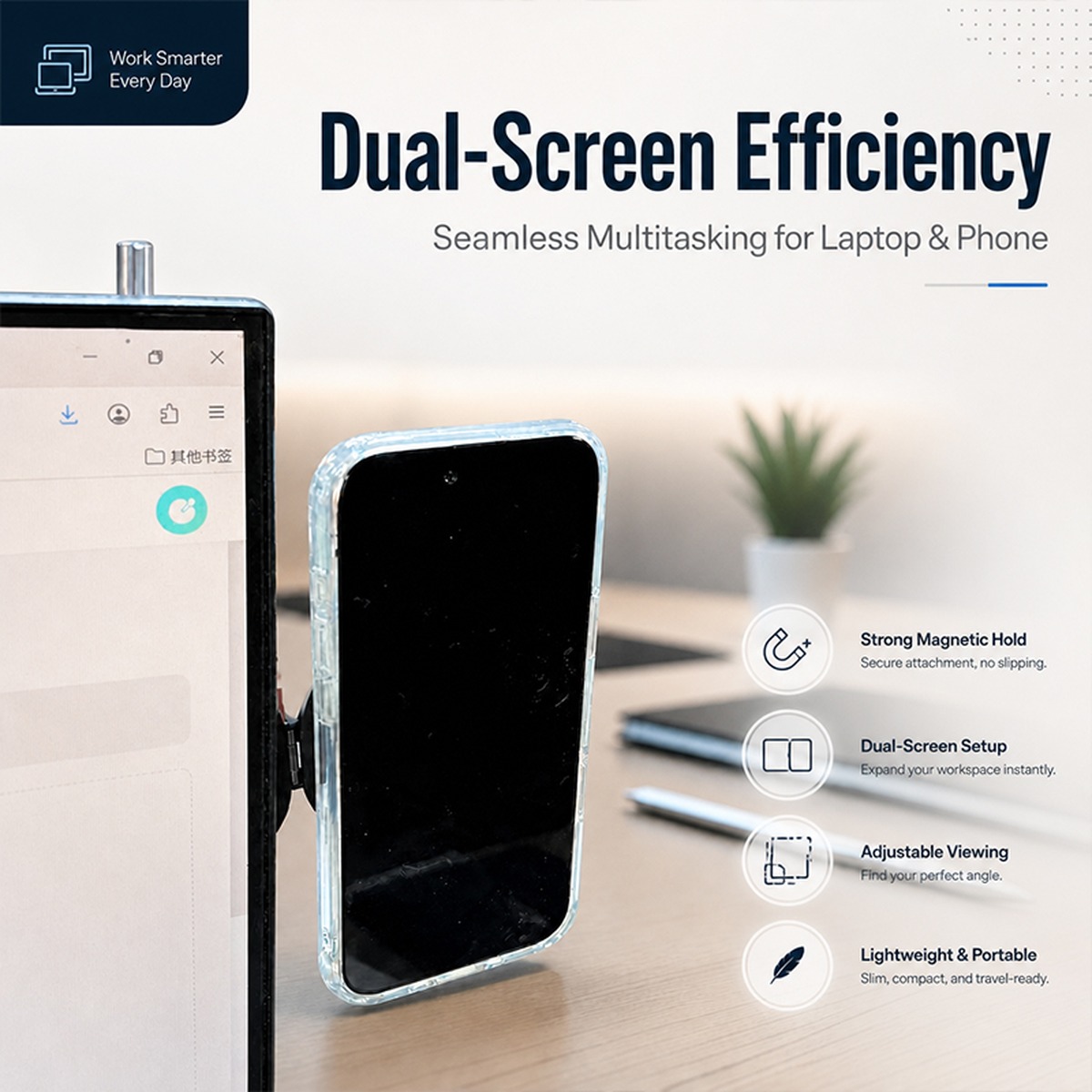
Direct answer: magnetic phone holder surface compatibility cannot be confirmed from the holder dimensions alone. The buyer should test the exact phone, case and mounting interface together, on every surface the product is expected to use, before production. X39 provides a published starting point: a 53.7 × 32.5 mm aluminum-alloy body with an N52 magnet assembly, 42 g finished weight, a foldable structure, double-sided magnetic attachment and published desk, laptop-side and car-use cases.
Those facts define the product. They do not replace a fit test with the buyer’s actual phone and surface. A holder can look correct in a catalog image and still fail because the case, receiving plate or intended installation position was different from the one tested.
1. Map every surface the product must meet
Start with a compatibility matrix. Record the phone model, case material and back surface, magnetic plate or receiving interface, mounting surface, expected angle and load. Keep desk, laptop-side and car configurations as separate columns rather than treating “magnetic” as one universal result.
For a desk, record where the holder sits and which direction the phone faces. For laptop-side use, record the available clearance and whether the product may touch the screen, keyboard or ports. For car use, identify the receiving mount and installation position rather than recording only the vehicle model. Each configuration should have its own sample photograph and approval result.
2. Test the real phone and case
Use the exact phone and case that the buyer intends to sell with the holder. Record the phone model, case material, case-back texture, and whether the customer will use a separate magnetic plate or another receiving interface. If the range covers materially different case types, test each one. A passing result on one combination should not be generalized to another.
For each test, place the phone on the holder without forcing the interface, set the holder to the intended angle, leave it in position and check whether the relationship changes during normal handling. Take photographs from the front, side and mounting interface. A front image alone does not show stability, contact or camera clearance.
3. Check both faces of a double-sided holder
A double-sided holder has two interfaces. One meets the phone or case, while the other meets the mounting surface. X39 is published as a double-sided magnetic folding stand, so the complete test chain is phone, case, holder and mounting interface. Test both sides and record them separately.
This distinction matters for purchasing descriptions. “Double-sided” explains the construction, but it does not prove that a particular phone, case and car-mount surface form a usable combination. Compatibility must be shown by the approved sample and retained test record.
4. Freeze the tested configuration
Create an approval record containing the model and drawing revision, phone model, case material and back surface, mounting interface, holder angle, inspection photographs and pass/fail result. Retain one golden sample. Any later change to the phone, case, plate, holder structure or mount should be reviewed against that record before production.
This prevents sales from describing one combination while production builds another. It also provides a practical basis for customer instructions: users should be told which phone, case and interface were tested rather than being given a blanket “compatible with all” claim.
5. Put the compatibility requirement into the sample request
Send the target market, target quantity, phone model, case specification, intended mount, logo or packaging plan and required delivery date. Ask the supplier to identify the exact model and revision being quoted. Include photographs of the receiving surface and clarify whether the car or desk interface is supplied by the buyer or by the factory.
For ready-molded models, MOQ is 50 pcs per model. Samples take 7–10 working days after requirements are confirmed; mass production takes 7–12 days after sample approval, followed by 3–5 days for packing and final inspection, FOB Shenzhen. Review the <a href="../products/x39">X39 product page</a>, the <a href="../magnetic-car-phone-mount-manufacturer">car-mount OEM/ODM guide</a>, the published <a href="../facts">product facts</a> and the <a href="../answers">buyer answer library</a> when preparing the request.
6. What the approval record should contain
| Record | What to capture |
|---|---|
| Phone and case | Exact model, case material, back texture and thickness where relevant |
| Holder | Model, drawing revision, one face and second face, fold angle |
| Mounting interface | Desk position, laptop-side clearance or exact car-mount receiving surface |
| Sample evidence | Front, side and interface photographs plus a written pass/fail result |
| Change control | Any phone, case, plate, structure or mount change that requires re-testing |
The finished record should make the tested combination repeatable. “It fits” is not enough; the next person must be able to identify the exact phone, case, holder revision and mounting surface that were approved.
Need a price for your own model?
Send us your drawing or a reference photo. You will get unit price, sampling time and shipping cost within one working day.
Frequently asked questions
Can X39 be called universally compatible before a sample test?
No. Its published use cases are desk, laptop-side and car use, but the actual phone, case and mounting interface still require sample verification.
What should be recorded for a surface compatibility test?
Record the phone model, case material and back surface, holder model and revision, both holder faces, mounting interface, angle, photos and pass/fail result.
Should desk and car configurations be tested separately?
Yes. The receiving surface, installation position and clearance are different, so each intended configuration needs its own sample check and record.
What does double-sided magnetic mean for the approval record?
It identifies two interfaces: one facing the phone or case and one facing the mount. Both should be tested and recorded separately with the complete phone-and-case assembly.
What are the MOQ and sample lead time?
Ready-molded models start at 50 pcs per model. Samples take 7–10 working days after requirements are confirmed; production takes 7–12 days after sample approval, followed by 3–5 days for packing and final inspection, FOB Shenzhen.
Models mentioned in this guide